3Rs in action: Digital behaviour monitoring to improve welfare in research dogs
Research with dogs is necessary, particularly in veterinary medicine and veterinary education, where findings directly benefit animal health. At the same time, ensuring high standards of animal welfare is essential.
At the dog facility of the Vetsuisse Faculty (VSF) at the University of Zurich (UZH), dogs are housed in groups, cared for through no-stress handling and positive reinforcement training, and live within structured daily routines that include enrichment and social interaction (Fig. 1). Importantly, all dogs are rehomed to private owners once they are no longer involved in research.
But even in well-managed facilities, one key question remains: How can we measure welfare changes objectively and continuously without adding stress through additional handling of the animals?

From observation to objective data
Behaviour is one of the most important indicators of animal welfare. Traditionally, behavioural assessments rely on trained human observation. While valuable, such assessments can be subjective and difficult to standardise.
A pilot project funded by the UZH Office for Animal Welfare and 3R set out to explore a different approach. The project, led by PD Dr. Henning Richter and Dr. Miho Sato at the VSF Stiegenhof, tested whether computer vision and advanced behavioural sequence analysis could provide a more objective and reproducible way of assessing dog welfare.
“We used a computer vision method to make dog behaviour assessment more objective and found that dogs exhibit different posture patterns depending on the time of day.” Miho Sato explains.
How the system works
The team designed digital key points for dogs and trained computer vision models to detect individual body parts and distinguish between individual dogs in group housing (Fig. 2 a-c).
Using Behavioural Flow Analysis (BFA), they analysed how dogs move and interact over time. Rather than evaluating isolated behaviours, the method captures dynamic behavioural sequences allowing robust statistical comparison of behavioural patterns.
The pilot study revealed measurable differences in behavioural signatures between morning and afternoon awakening periods, while patterns remained consistent across different days (Fig. 2d and e).
This demonstrates that subtle changes in behavioural flow can be detected objectively without additional physical interaction.
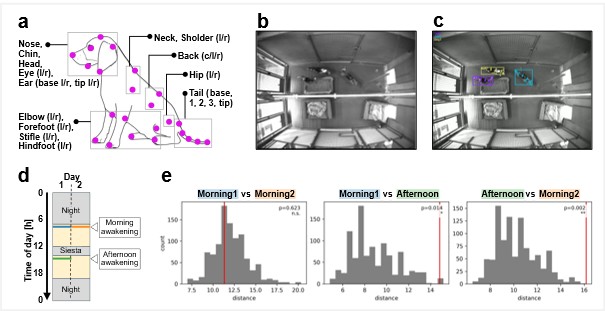
a) Key points design for dogs. b) Representative top-down view of a housing kennel with dogs. c) Three individual dogs identified with key points and bounding boxes using customised CV models (Dog1: purple, Dog2: blue, Dog3: yellow). d) 24-hr schedule of dogs selected for Behavioural Flow Analysis (BFA). Three 5-min awakening periods sampled either in the morning (Day 1: blue, Day 2: orange) or in the afternoon (Day 1: green). e) BFA reveals behavioural difference between two different awakening periods, but no significant differences between days.
Advancing the 3Rs through digital innovation
This project contributes to two of the 3Rs in animal research (replacement, reduction, refinement):
Refinement
Continuous, automated behavioural monitoring allows welfare assessment without additional handling or stress.
Reduction
More objective and consistent welfare data can reduce variability in studies potentially lowering the number of animals needed to achieve reliable results.
Beyond compliance, the project demonstrates something more fundamental: Digital tools can meaningfully improve animal welfare while strengthening scientific quality and reliability.
A plot with broader impact
The project was supported through internal pilot funding for innovative 3R approaches (AW&3R grant). As a seed project, it tested the feasibility of Behavioural Flow Analysis as a new analytical pipeline that builds on previous work funded by the Swiss 3R Competence Centre (3RCC). The analytical method could now be extended to monitor welfare changes across species and research facilities.
Projects like this show that advancing animal welfare and advancing science are not competing goals, they move forward together.